Stay in the loop
Get the latest news, feature updates, and exclusive promotions.
Use this expert-approved project management plan checklist to avoid failure, boost clarity, and hit every project goal.
Planning a project without a checklist is like flying blind. It’s risky, messy, and likely to fail.
In project management, this leads to going over budget, missing deadlines, and unhappy clients or teams.
According to PMI’s 2023 report, only 43% of projects stay on budget, and just 48% finish on time. These numbers show that better planning is needed right from the beginning.
This guide gives you the ultimate project planning checklist. It’s full of expert advice, real stories, and simple steps you can follow.
No matter if you use Agile, Waterfall, or a mix of both, this checklist will help you go from messy planning to smooth success.
According to ProProfs Project, the top reasons for failed projects include:
🗣️ Antonio Nieto-Rodriguez, HBR: “The problem is not project failure. It’s poor planning. Great projects begin with even greater plans.”
🗣️ Susanne Madsen, Project Leadership Coach: “A good project management plan is not just a Gantt chart. It’s a mindset of foresight, coordination, and leadership.”
🗣️ PMI Thought Leadership: “Projects fail not because of bad execution, but because of vague objectives, weak planning, and lack of stakeholder engagement.”
A 2024 Wellingtone survey showed 54% of teams lack real-time visibility into project status. This usually happens due to poor planning systems.
Most planning failures come from skipping simple but critical steps, not random surprises. Planning right avoids problems later in the project.
Use this checklist to prepare every part of your project before starting.
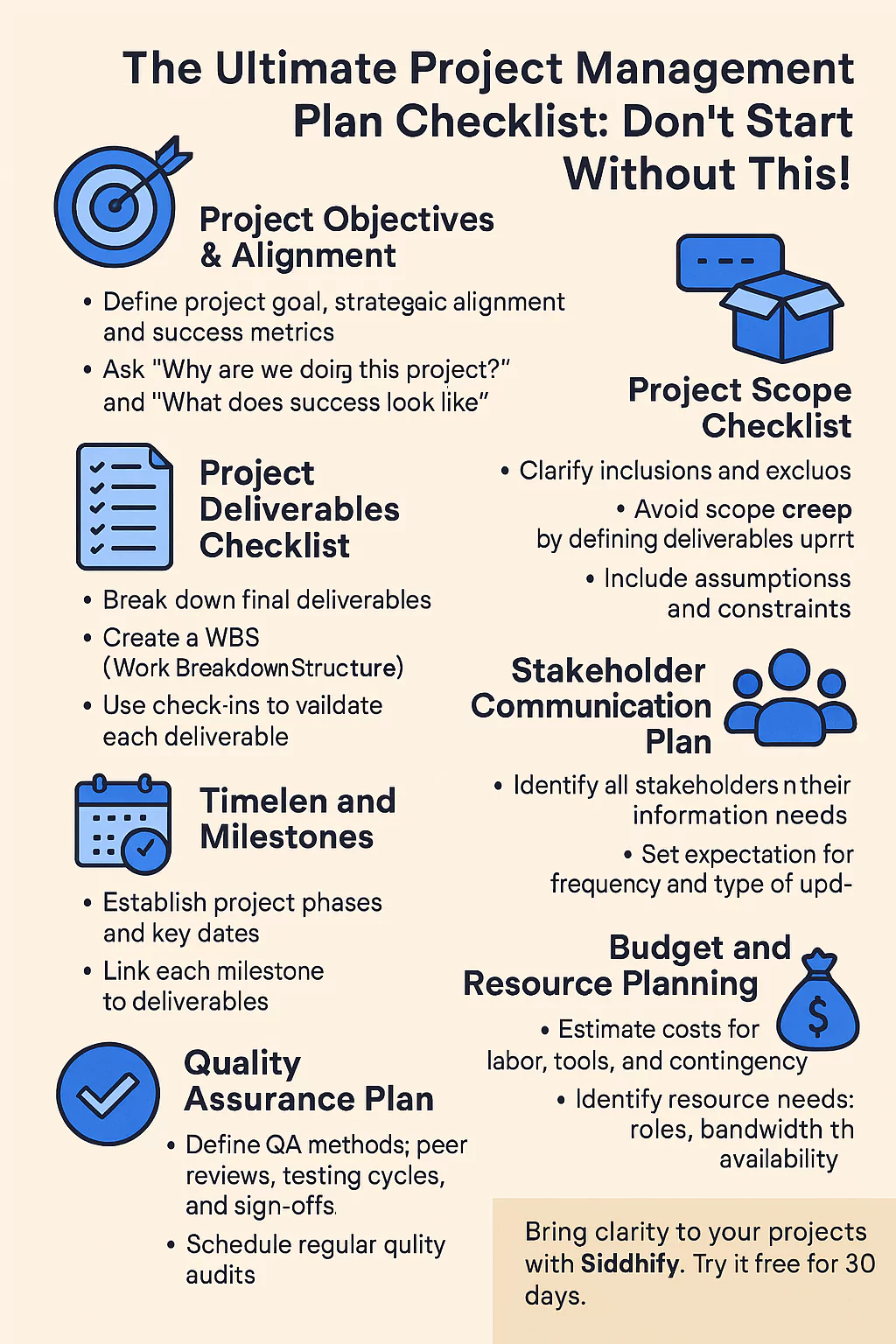
Set clear goals so your project matches your business strategy. Ask yourself: “Why are we doing this?” and “What does success look like?”
Use SMART goals: Specific, Measurable, Achievable, Relevant, Time-bound. Make sure all major stakeholders agree on what success means.
Pro Tip: Align project goals with both your company strategy and stakeholder needs. This keeps everyone focused and motivated.
PwC’s 2023 report says projects with clear objectives are 2.5x more likely to succeed. Good goals give your team direction and reduce confusion.
Clear objectives also make reporting easier. Everyone will know if the project is on track or needs help.
Scope tells you what’s in the project and what’s not. Start by listing deliverables, limits, rules, and key assumptions.
When you write down what’s excluded, you help avoid scope creep, which affects 27% of projects.
Pro Tip: Add a section for assumptions and constraints. This increases transparency and helps with better decisions later.
Wrike’s 2024 study found that teams with formal scope planning saw 42% fewer changes mid-project. A clear scope makes expectations easier to manage.
You’ll save time by avoiding unnecessary debates later. Stakeholders will also feel more confident about what to expect.

Break the project into clear parts using a Work Breakdown Structure (WBS). Each part should match a goal from the objectives section.
Add checkpoints to make sure progress is on track. Check if deliverables meet quality standards at each step.
Tools: Siddhify lets you track deliverables with tags, milestones, and checklists. It helps busy teams stay organized without stress.
According to Harvard Business Review (2023), using WBS improves deliverable quality by 31%. A better structure brings more success.
It also keeps teams accountable. Everyone knows what’s expected and when.
Identify who your stakeholders are and learn what they care about. Decide how often and in what format they should get updates.
Use a RACI matrix (Responsible, Accountable, Consulted, Informed) to keep communication organized.
Real-World Insight: NASA’s Mars Rover succeeded because of strong communication between many teams and experts.
McKinsey (2024) found that solid communication plans increase project success by 47%. It’s one of the most powerful tools in planning.
When people know what’s happening, they stay involved and supportive. You also avoid confusion and duplicate work.
Make a clear timeline with stages, key dates, and tasks that depend on each other. Each milestone should match a deliverable or a big decision.
Use Gantt charts or Kanban boards to help visualize your plan and track progress.
Only 48% of projects finish on time, mostly because of bad scheduling or poor tracking.
Teams that use milestone software have 33% fewer delays. A visible timeline helps everyone stay on track.
It also gives you early warnings if things are off-schedule. That way, you can fix issues before they become major problems.
List all costs, tasks, roles, materials, and add a buffer for risk. Watch out for hidden costs like licenses or last-minute help.
Check each person’s actual availability, not just their name on a task. Overloaded team members can cause delays.
Example: IBM’s Phoenix Project got back on track by fixing how it managed people and updating its budget.
Planning well means looking at time, money, and people.
Use tools to track both time and spending. This helps you stay in control during the project.
Start with a risk register. List possible risks, how likely they are, how big their impact is, and how to handle them.
Use a probability-impact matrix to sort risks and assign owners for each.
Stat: 23% of failures happen because teams skipped risk planning.
Expert Tip: “Planning is the antidote to chaos.” – Susanne Madsen
PMI research says teams with proactive risk plans are 40% more successful. A little early work can prevent huge problems.
Risk management builds confidence. Teams feel ready to handle what comes next.
Set checkpoints for peer reviews, approvals, and user tests. Don’t wait until the end to focus on quality.
Make QA (quality assurance) part of every task, not just the final one.
That saves time and improves client satisfaction.
Good QA builds trust. Everyone knows the final product will meet standards.
Set clear rules for how to request, approve, and track changes. Include a change log to explain what was changed and why.
Changes should be reviewed by a board or key decision-makers. Update documents to show how each change affects the budget or time.
Pro Tip: A detailed change log prevents mistakes and helps with future planning.
Strong change controls reduce cost overruns by 32%. Clear steps = fewer surprises.
This also helps you explain decisions to stakeholders. It keeps everyone aligned even when things shift.
Hold a final meeting (retrospective) with your team and stakeholders. Talk about what went well and what could improve.
Compare the results with the original plan. Write down lessons so your next project is even better.
Real-World Example: IBM’s success came after deep post-project reviews that improved processes across the company.
This also builds a culture of reflection. Teams feel their input matters.
Agile teams need to plan for sprints, backlog grooming, daily stand-ups, retros, and reviews. Agile works best in short, repeating cycles.
Every sprint should include goal setting, feedback, and improvements.
Stat: ResearchGate reports that Agile projects are 28% more successful than traditional ones.
Atlassian (2024) says Agile teams using checklists reduce sprint delays by 35%. Structure makes Agile faster and smoother.
Waterfall requires planning every detail upfront. Use the checklist to build phase-by-phase goals and approval points.
Hybrid methods blend Agile and Waterfall. These projects need solid plans with flexibility for fast updates.
PMI says hybrid methods grew 34% since 2022. Many small teams and startups love this flexible approach.

NASA’s Mars Rover (Success)
Strong planning, clear goals, and good communication made this project a win. They made small changes without losing track of the big picture.
Denver Airport Baggage System (Failure)
No risk plan and no backup caused huge delays and losses. It’s a classic example of planning failure.
IBM Project Phoenix (Turnaround)
Started off-track, but saved by using a project checklist to reset goals, budget, and team roles. A structured plan helped recover a $5B effort.
A full plan has goals, scope, timeline, budget, resources, communication, QA, risks, and a review plan.
Initiation, Planning, Execution, Monitoring, Closure.
It’s a list of key tasks that ensures you don’t miss important planning steps.
Poor planning, weak communication, scope creep, and missed risks.
Use a checklist, talk to your team early, and connect goals to business needs.
A project checklist isn’t red tape, it’s your secret weapon. Projects with strong plans are 28% more likely to succeed.
Don’t leave your project up to luck. Use this checklist to align your team, set goals, and deliver great results.
Call to Action:
Bookmark this checklist and use it before your next project.
Share it with your team so everyone starts on the same page.
Try Siddhify’s all-in-one planning toolkit, perfect for entrepreneurs and growing teams. From smart checklists to milestone tracking, it brings structure to your workflow and clarity to your chaos. Sign up today and make your next project your best one.
Project Management Plan Checklist: 10 Essentials for a Successful Project (+Pro Tips)
Join thousands of entrepreneurs and professionals managing their work and life in one place — with the motivational power of gamification built right in.
⚡ Try Siddhify Free TodayNo credit card required · Set up in minutes