Stay in the loop
Get the latest news, feature updates, and exclusive promotions.
Master agency project management with proven workflows, metrics, and processes that boost delivery and profitability. Get actionable tips & tools from Siddhify.
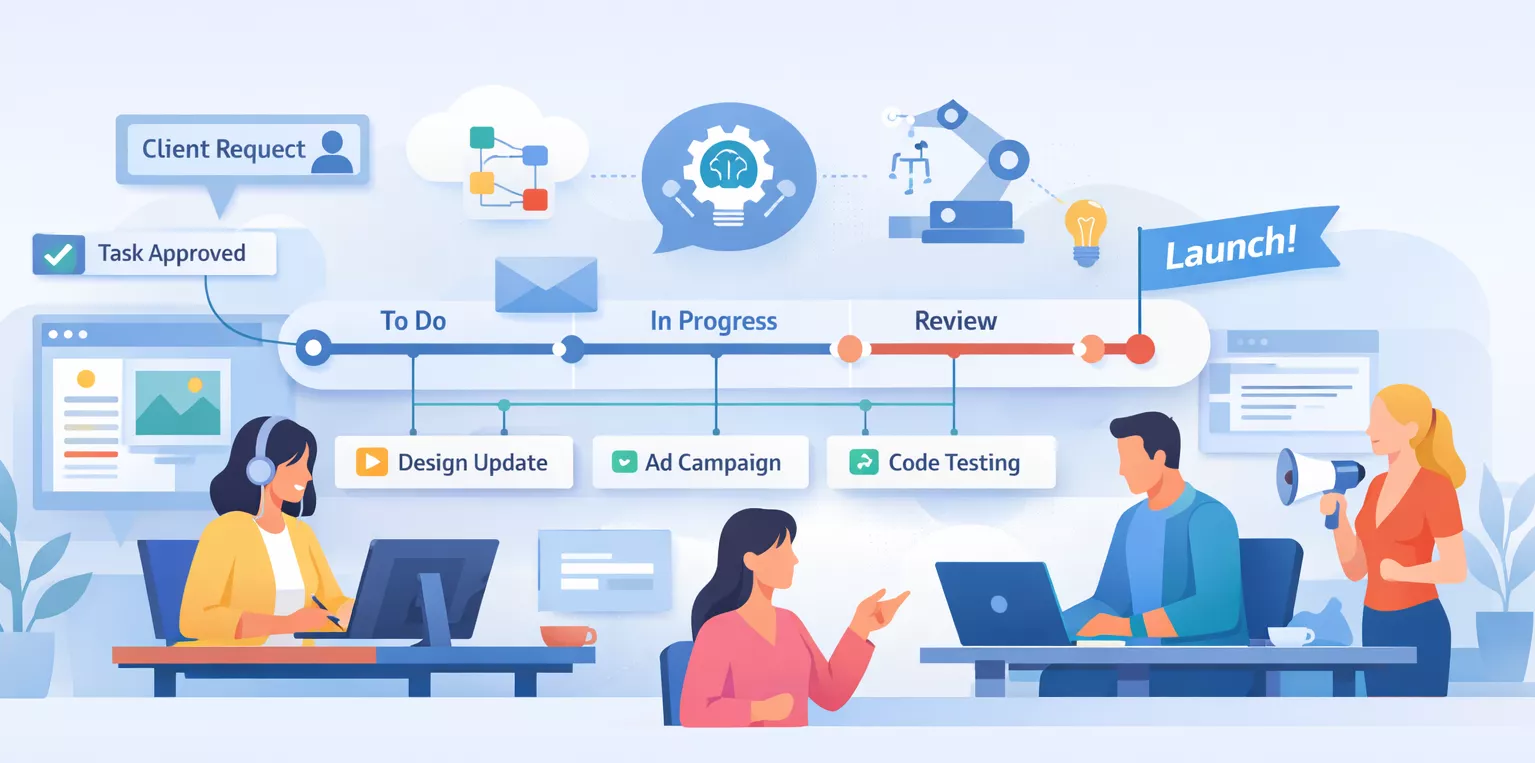
Here’s what I’ve seen happen time and again: agencies grow their client roster just fine, but their delivery processes collapse under the weight.
When you’re starting out, you can run on pure hustle: late nights, talented people who care, and sheer determination to make clients happy. That works brilliantly… until it doesn’t.
Once you hit 10, 15, 20 clients, the cracks start showing: double-booked designers, projects that somehow lose money, clients expecting miracles on impossible timelines.
Project management in 2026 isn’t just about ticking off tasks anymore.
You need to actually deliver on time (novel concept, right?), keep projects profitable, and maintain trust with people who have zero patience for excuses.
Clients expect Slack responses in minutes, budgets are tighter than ever, and everyone’s using AI to work faster, which means they expect you to move faster, too.
I’m not here to bore you with theory.
This guide covers what agency PM actually looks like in the wild, why it falls apart (and how to fix it), what changes as you scale, and how the right tools can help you grow without burning out your team or your margins.
Agency project management is how you plan, run, and finish client work without losing your mind or your money.
You’re juggling what clients want, when they want it, who’s available to do it, and whether you’ll actually turn a profit.
Why does this matter? Because running projects for clients who pay you is completely different from managing your own company’s internal stuff. You’re not just shipping work, you’re doing it profitably, dealing with people who change their minds constantly, and making calls when you’ve only got half the information you’d like.
Every project carries risk:
Good project management exists to keep these risks from killing your business.
In practice? That means wrangling client requests, keeping scope from ballooning, making sure everyone knows what they’re supposed to do, actually doing the work, managing the inevitable rounds of feedback, and tracking whether you’re making or losing money on each project, ideally all in one place instead of across seventeen different tools.
Spread that across Asana, Google Sheets, Slack, email, and someone’s personal notebook? Good luck knowing if you’re profitable until the project’s already done.
If you want a deeper breakdown of how agencies structure this in practice, I’ve covered it in detail in project management software for digital agencies.
Traditional PM assumes you’re working with the same team, on predictable priorities, with relatively stable requirements. Agency life? Not even close. Everything shifts constantly.
Agency projects typically involve:
This is exactly why Monday.com or Jira often feel like they’re fighting you instead of helping you. They weren’t built for this. A 3% margin slip on a few projects?
That’s the difference between a profitable quarter and explaining to your team why bonuses are smaller this year.
Small problems compound fast in agency work. What starts as “just a few extra revisions” becomes a money-losing project and a client who thinks you can’t estimate accurately.
Pull up your P&L from last quarter. Look at which projects made money and which ones didn’t. That’s where your problems are hiding.
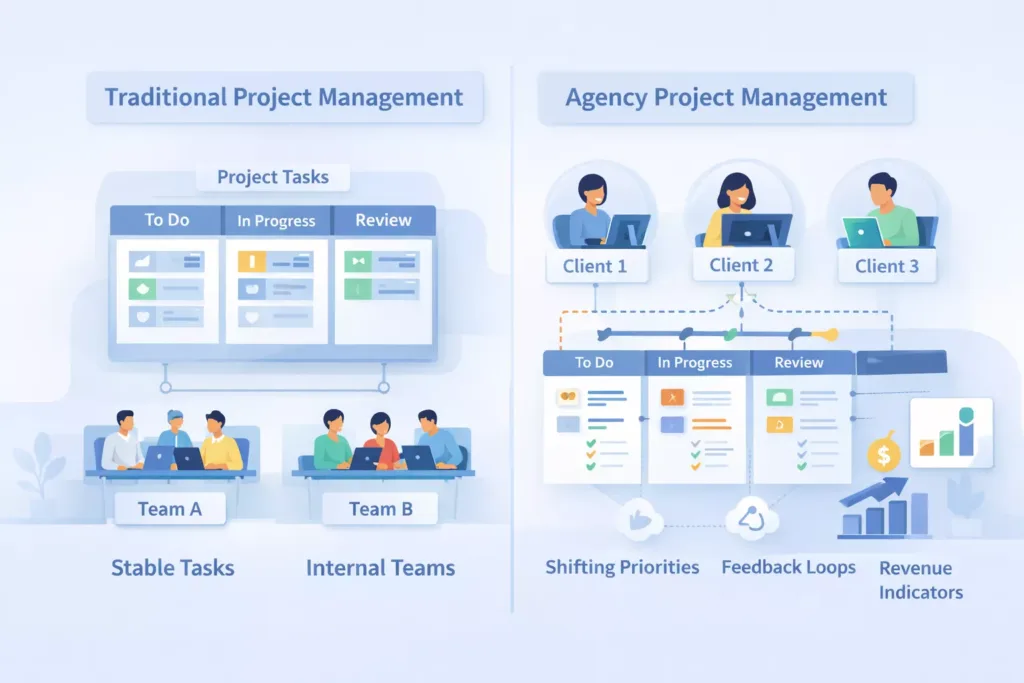
Most agency founders possess a basic understanding of project management principles.
However, the main issue arises from their reliance on systems originally developed for software or construction industries rather than for agencies that bill hourly and must accommodate subjective client feedback.
According to the New PMI Survey, 97% of agencies experienced significant challenges with creative campaigns.
Agencies reported their project management tools were not tailored to address the unique dynamics of creative client work, contributing to inefficiencies and margin erosion.
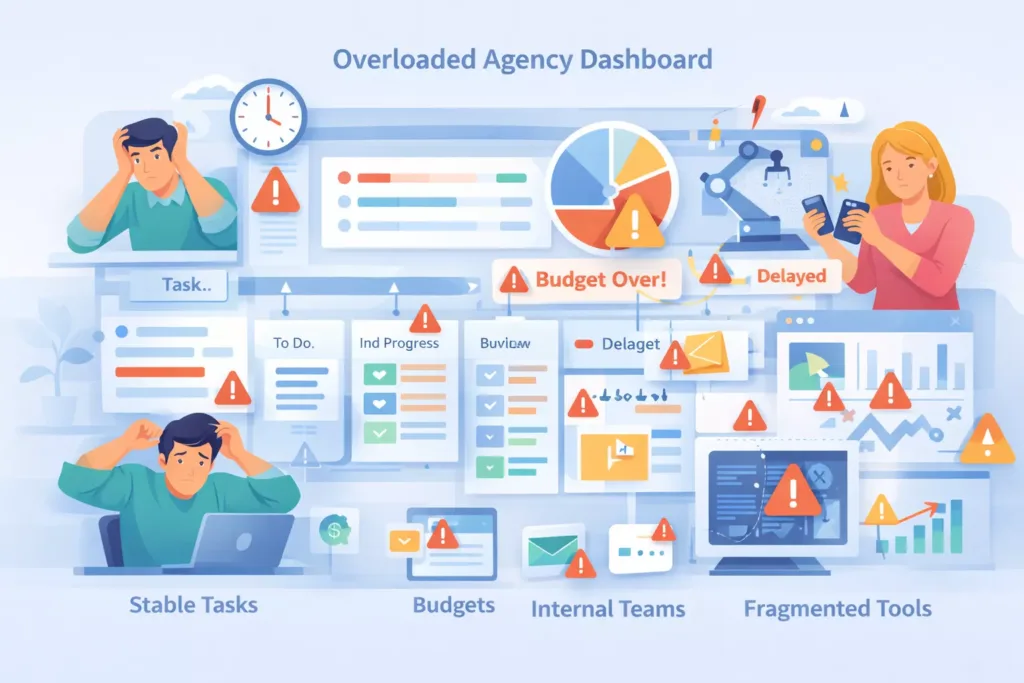
Take a typical engineering PM tool. Great for tracking who’s doing what. Terrible at showing you that Sarah’s booked at 110% next week, that the Henderson project is bleeding hours, or that you’re about to hit capacity and should stop taking new work.
Then there’s role confusion. Your PM moves tasks along but doesn’t actually own the outcome. Can they push back when a client wants something out of scope? Do they even know the project’s hemorrhaging money? Usually not.
It never announces itself. Consider, for example, a mid-sized branding agency that agreed to a fixed-scope website redesign for a client.
After project kickoff, the client requested ‘just one quick call,’ followed by ‘a small tweak’ on the homepage design, and then, several weeks later, asked if the agency could ‘explore another direction’ for the color palette.
None of these informal requests was formally documented or included in the project scope. Yet each required unplanned hours from designers and project managers.
By the end of six weeks, the agency had delivered almost double the work originally agreed upon for the same fee.
And capacity planning? Most agencies look at it once a month, if that. By the time you notice everyone’s drowning, it’s too late, you’re already behind, your team’s already fried.
The agencies that don’t implode? They check capacity weekly. Spot the problem on Monday, fix it before it becomes a crisis.
Once people burn out, your quality’s already tanked. At that point, everyone’s just guessing and hoping instead of actually knowing what’s happening.
Agencies that scale well don’t wing it. They follow the same playbook every time, which means fewer surprises and earlier warning signs when something’s off.
Day 1? Kickoff meeting. Everyone knows what we’re doing and who’s doing it.
Day 7: first draft done, team reviews it internally before the client sees anything. Day 10: client gives feedback. Repeat. Simple, repeatable, no drama.
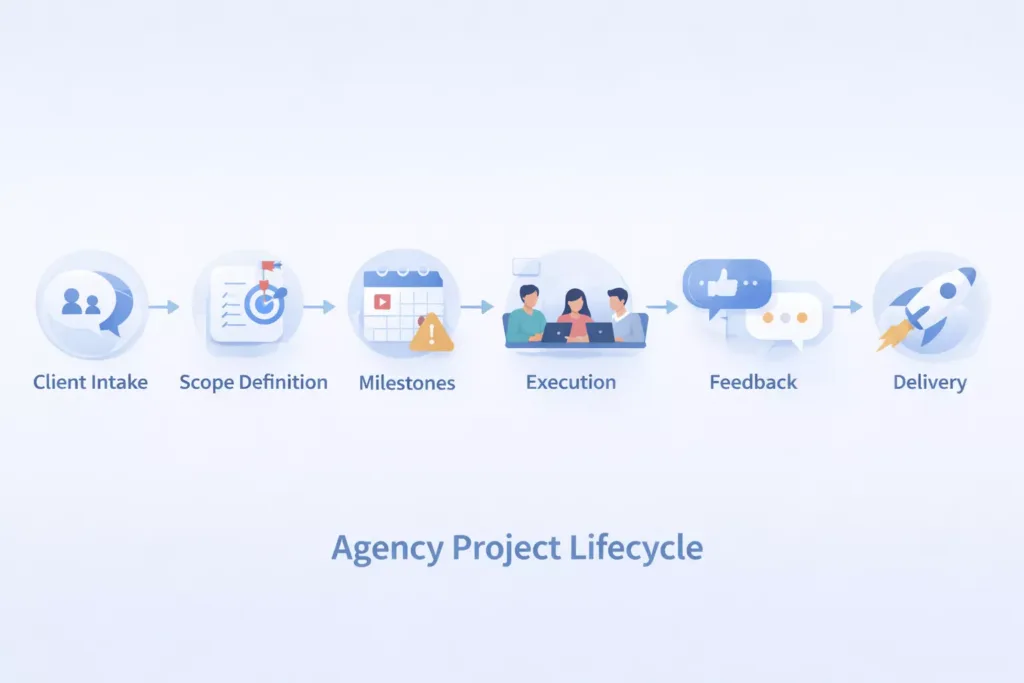
Here’s the process that actually works, whether you’re 5 people or 50:
Every project starts the same way: turn the client’s vision into actual tasks, deadlines, owners, and approval stages. Just as important? Writing down what’s NOT included.
That’s your scope protection for later when they inevitably ask for more.
Before anyone opens Figma or writes a line of code, agree on what success looks like. For example, establish clear key performance indicators (KPIs) such as achieving an 80% on-time milestone delivery rate or maintaining billable utilization at or above 75%.
Identify the must-hit dates, confirm which team members are actually available (not just those you hope will be free), and specify the project budget.
This is the stage where agencies often overcommit by saying yes out of optimism instead of accurately assessing capacity.
Getting this step right with concrete metrics in place protects both your margins and your team’s well-being.
Chop projects into phases with real checkpoints, not fake milestones that don’t mean anything. These are your early warning systems.
Miss one and you know immediately, not three weeks later when you’re supposed to be launching.
While work’s happening, everyone should be able to see what’s done, what’s blocked, and what’s on fire without you having to ask in Slack seventeen times a day.
The goal is to spot problems early, not hover over people’s shoulders.
Client feedback needs structure: scheduled review points, everything documented, and formal sign-offs. Changes happen – fine.
But they happen intentionally, with everyone aware of the impact, not as surprise requests in email subject lines.
When it’s done, take 20 minutes to write down what worked and what didn’t. Did you underestimate design time again? Did the client approval stage drag?
These notes make your next estimate actually accurate, not just wishful thinking.
By adhering to this process, agencies shift from a reactive to a proactive approach, enabling them to anticipate and address issues before they escalate.
This not only reduces operational chaos but also delivers tangible financial benefits, directly supporting the broader thesis that robust project management practices are essential for sustainable agency growth and predictable profitability.
While financial improvement is a significant benefit, the more substantial achievement lies in fostering organizational stability and client confidence.
By adopting structured project management processes, agencies not only reduce internal disarray but also consistently demonstrate professionalism to clients.
Ultimately, embracing these practices positions your agency for sustained growth and sets a foundation for continued client trust and operational excellence.
Begin implementing these strategies now to ensure your agency’s resilience and future success.
Distinct agency types require tailored project management strategies due to fundamental differences in their workflows, client expectations, and deliverables.
For example, the processes effective for a branding agency, which often focuses on creative, iterative output, are not suitable for a performance marketing agency, where data-driven results and rapid campaign adjustments measure success.
Creative work is subjective by nature; what looks brilliant to you might fall flat for the client. Expect revisions. The trick is having clear approval stages so “one more round” doesn’t turn into round 47.
Marketing agencies are juggling retainers, active campaigns, monthly reporting, and constantly shifting priorities based on performance. Your PM system needs to handle recurring work, not just one-off projects.
For example, consider a digital marketing agency managing a six-month paid search retainer for a retail client. Each month includes scheduled tasks, such as keyword research, ad copy updates, and A/B test deployments.
Account managers review cost-per-click and conversion metrics every Friday, document findings in a shared dashboard, and coordinate adjustments with creative leads each Monday.
Mid-month, campaign results trigger budget reallocations and require collaborative input from both paid media and analytics teams.
This cycle repeats monthly but is systematically tracked through the agency’s project management platform, ensuring accountability, timely reporting, and rapid iteration in response to performance data.
Marketing agencies are juggling retainers, active campaigns, monthly reporting, and constantly shifting priorities based on performance.
Your PM system needs to handle recurring work, not just one-off projects.
This is where choosing the right platform matters, especially software designed specifically for agency workflows. I break this down in more detail in project management software for marketing agencies.
Performance agencies live and die by results. Budgets shift based on what’s working. Timelines compress when something’s hot.
You need workflows that can pivot fast without losing track of what you’re trying to accomplish.
Dev and product shops deal with dependencies (can’t do B until A ships), hard constraints (not preferences – actual technical limits), and mid-project change requests that blow up timelines.
You need bulletproof change control and realistic schedules, not the timeline the client wants to hear.
Bottom line: copy-pasting someone else’s process won’t work. Your PM approach needs to match how your agency actually delivers value.
The agencies that scale without imploding? They all do a few things the same way:
They use the same intake forms, kickoff templates, and delivery checklists.
Every project starts the same way – clearly. Most of them also do a quick Monday morning capacity check: 15 minutes, all the team leads, one question: who’s slammed and who has room?
In that meeting: what’s live, what’s about to become a problem, can we shift anything around? Everyone leaves with clear priorities for the week. No surprises, no guessing.
This is how you catch overload before it breaks people. And every single task has one name attached, not “the team” or “design,” but Sarah or Marcus. One person, one outcome.
They update clients before clients have to ask. “Here’s where we are, here’s what’s next, here’s the one thing we need from you.” Builds trust, prevents panic emails.
Their PMs actually understand the money side. They know that saying yes to a deadline change means eating hours.
They see when a project’s about to go underwater and flag it early, not after you’ve already lost margin.
The best agencies aren’t just managing tasks. They’re managing expectations, risk, and margins, all at once, all the time.
Track the right numbers, and PM stops being guesswork. It becomes strategic.
Billable utilization: what percentage of your team’s time actually makes money? If this number’s dropping, you’re either doing too much non-billable work (internal projects, endless sales calls) or your planning’s off, leaving people idle between projects.
On-time milestone delivery: are you hitting your checkpoints? If you’re consistently late, the problem started earlier, bad scoping, or an overloaded team usually.
Budget vs. actuals: did you estimate 40 hours and spend 65? Track this religiously, and your estimates get better. Ignore it, and you’ll keep underpricing projects forever.
Client satisfaction and retention: are clients happy enough to come back? This tells you if you’re delivering beyond just the work itself: communication, process, and the whole experience matter.
Planned vs. actual capacity: if you keep thinking people have 20 hours free but they actually have 5, you’ll never know when to hire, how to price, or whether you can take on that big opportunity. Get this right, and you can grow confidently instead of reactively.
Metrics do not replace judgment, but they significantly enhance decision-making.
Siddhify’s AI-powered features for task and project management
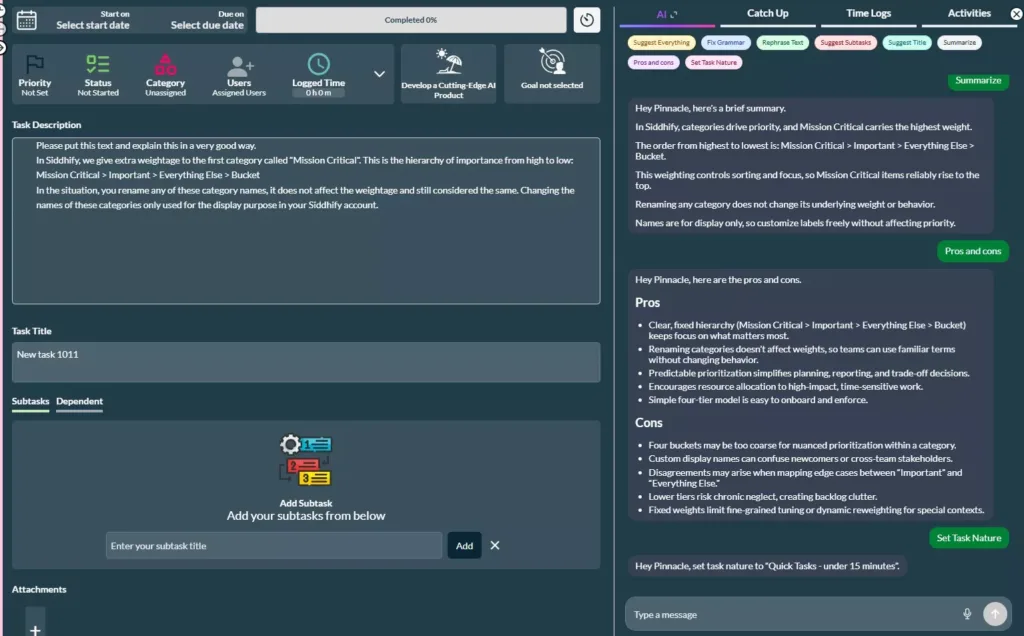
AI’s not a buzzword anymore. By 2026, it’s just part of how agencies run.
The good AI implementations don’t replace your PMs – they make them better.
Modern platforms are starting to bake these capabilities directly into daily workflows, especially tools that focus on AI project management software features like predictive workload planning, automated risk detection, and smart prioritization.
AI can help prioritize what’s urgent vs. what just feels urgent, spot patterns that signal a project’s going off the rails, suggest who should work on what based on availability and skill, and generate those reports nobody wants to create manually.
But humans still make the calls. AI surfaces information; you decide what to do with it. Think of it as a really good analyst who never sleeps, not a replacement for judgment.
The win? You spend time interpreting data instead of collecting it. Which means you can move faster and plan smarter, even as everything gets more complicated.
Siddhify’s tasks dashboard is specially designed for digital agencies
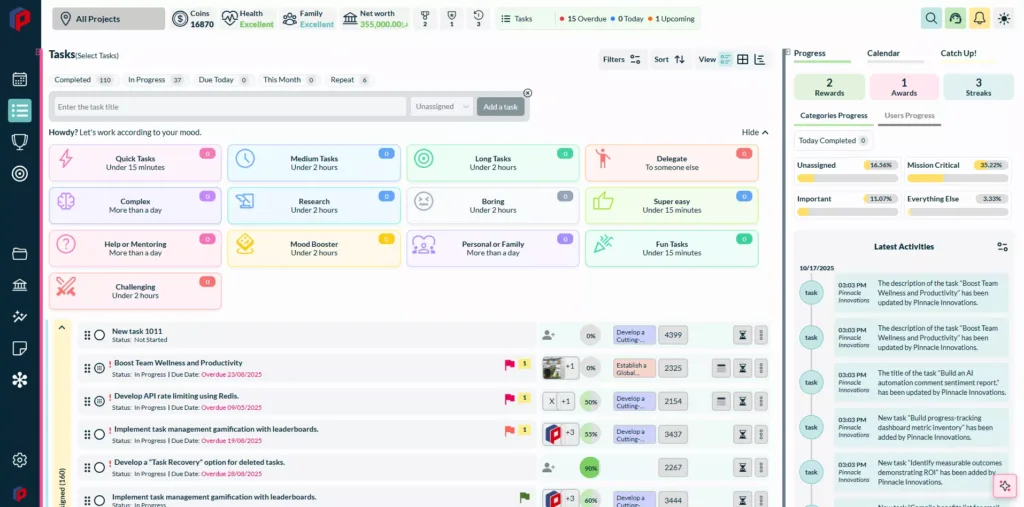
Here’s the thing about most PM tools: they were built for internal teams at tech companies. Great at tracking tasks, terrible at showing you whether you’re making or losing money on client work.
Siddhify was built specifically for agencies.
If you want a full breakdown of how it compares to traditional tools, this guide on project management software for digital agencies goes deeper into the operational differences.
Unlike traditional project management tools such as Asana or Jira, which primarily focus on tracking individual tasks and often require extensive manual coordination across multiple platforms, Siddhify integrates delivery tracking, resource availability, and financial performance assessment into a unified workflow.
The AI component not only assists in prioritizing urgent tasks and identifying emerging risks but also reduces the reliance on manual data aggregation typically required in spreadsheet-based systems.
This holistic approach enables agencies to manage projects more efficiently and make data-driven decisions within a single platform.
You can see in real time how busy your team is and whether projects are profitable. Which means you can actually run your agency instead of constantly reacting to fires.
Everything from intake to invoicing lives in one place. No more tool-hopping between Asana, Harvest, Notion, and whatever else you’re juggling.
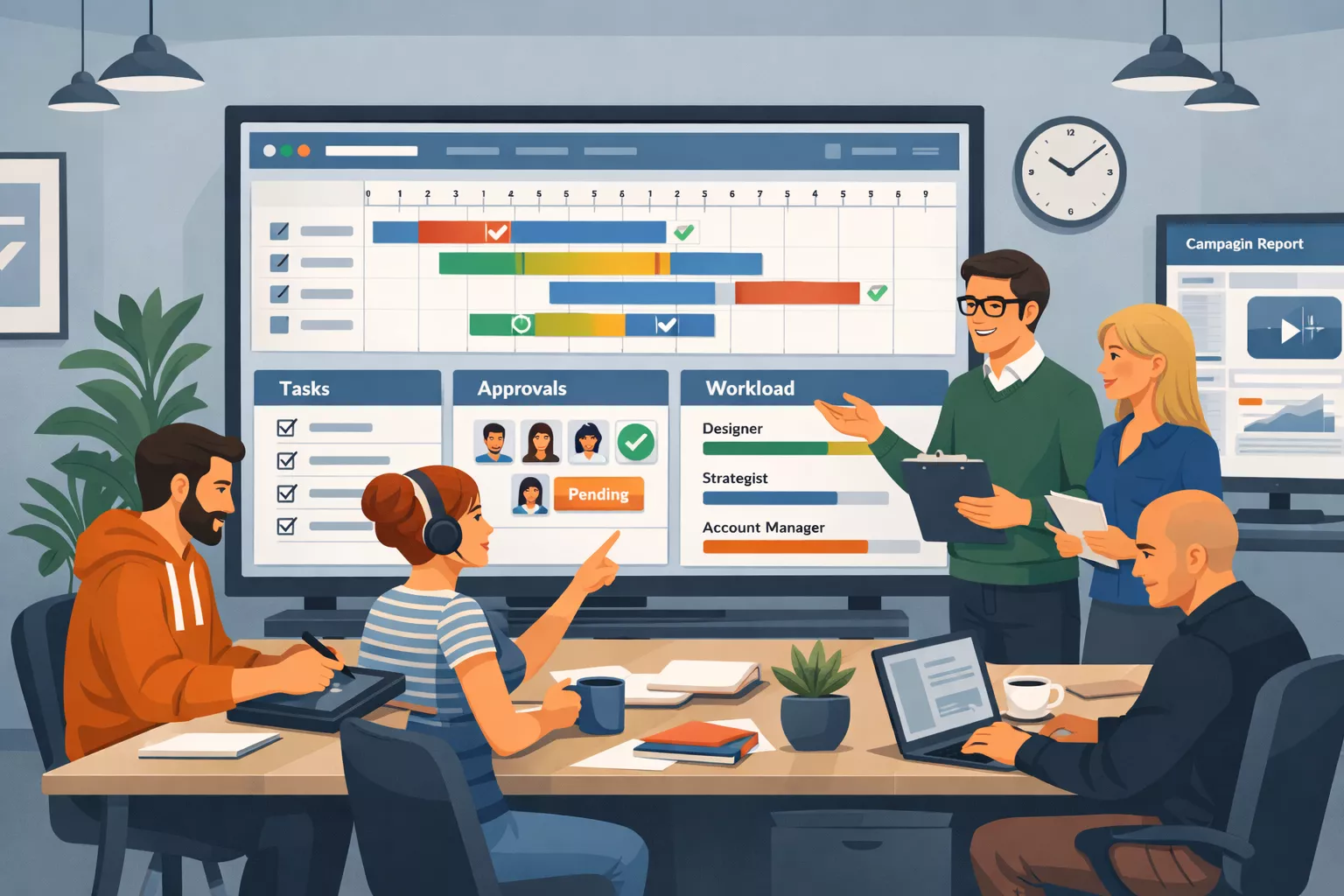
The dashboards show you who’s overloaded, what’s due, and how projects are performing right now, not after you export data to Excel and spend an hour making pivot tables.
If you’re evaluating tools more broadly, I also put together a practical comparison of the best SaaS project management tools in 2026 based on real agency use cases.
Agencies use Siddhify to:
If budget is a concern, Siddhify also offers a strong entry-level option – here’s a breakdown of its best free project management software features.
The result? Less chaos, more predictability. You actually know what’s happening instead of constantly asking around.
It’s how you plan, run, and finish client projects while staying profitable and keeping everyone: clients, team, leadership – on the same page.
Write down exactly what’s included (and what’s not). Make clients formally request changes. Tie every approval to the timeline and budget impact. No exceptions.
Billable utilization, on-time delivery, budget vs. actuals, and client satisfaction. Those four tell you almost everything you need to know.
Absolutely. It helps you prioritize better, forecast more accurately, spot risks earlier, and kill a ton of admin busywork.
When you’re constantly scrambling to figure out who’s working on what, when projects keep going over budget, or when your team’s burning out from the chaos, that’s when.
Look, you can’t scale an agency without solid project management. Try it, and you’ll hit a wall: deadlines slip, margins shrink, people burn out. I’ve seen it happen dozens of times.
Get your processes tight, track the metrics that matter, and use tools that actually help – you’ll stop firefighting and start growing predictably.
Your clients get clarity, your team gets confidence, and you finally get control.
That’s what Siddhify does: it connects delivery, capacity, and profitability so you’re working from data instead of gut feel. Less stress, more structure, better decisions.
If you’re serious about scaling this year, this isn’t optional anymore. Start by honestly assessing where your processes are breaking down. Then find tools built for how agencies actually work.
Want to see how this works in practice? Book a demo with Siddhify. The agencies that fix this stuff now are the ones that’ll still be thriving in three years.

Join thousands of entrepreneurs and professionals managing their work and life in one place — with the motivational power of gamification built right in.
⚡ Try Siddhify Free TodayNo credit card required · Set up in minutes