
Stay in the loop
Get the latest news, feature updates, and exclusive promotions.
Discover how the best employee wellbeing apps like Siddhify boost productivity, reduce burnout, and deliver measurable ROI. Learn how to choose, pilot, and scale wellbeing tools in 2026.
This guide argues that using a clear, fact-based approach to review employee wellbeing apps is crucial for organizations that want to address workplace stress and declining engagement.
It provides HR professionals and leaders with a step-by-step plan for selecting, testing, and evaluating the effectiveness of these apps over 90 days.
By outlining the key factors to consider and providing guidance on measuring results, this guide helps establish clear goals and informed decisions about using digital wellbeing tools.
Teams showing signs of burnout or declining connection aren’t just a people issue; they are a business risk.
According to the World Health Organization, an estimated 12 billion working days are lost each year to depression and anxiety, with a global cost of around US$1 trillion in productivity lost.
To put this into perspective, this is equivalent to losing approximately 50 full-time jobs annually in a company of 1,000 employees.
McKinsey research indicates that investing in holistic employee health can unlock up to US$11.7 trillion in economic value globally, with measurable gains in productivity, retention, and engagement.
This guide is designed for CEOs, HR leaders, and managers who seek more than just theory. It offers a practical, data-driven roadmap. You’ll learn how wellbeing apps drive ROI, which features matter, how to run a pilot, and where Siddhify fits in.
An employee wellbeing app is a digital tool that helps employees with their mental, physical, and emotional health.
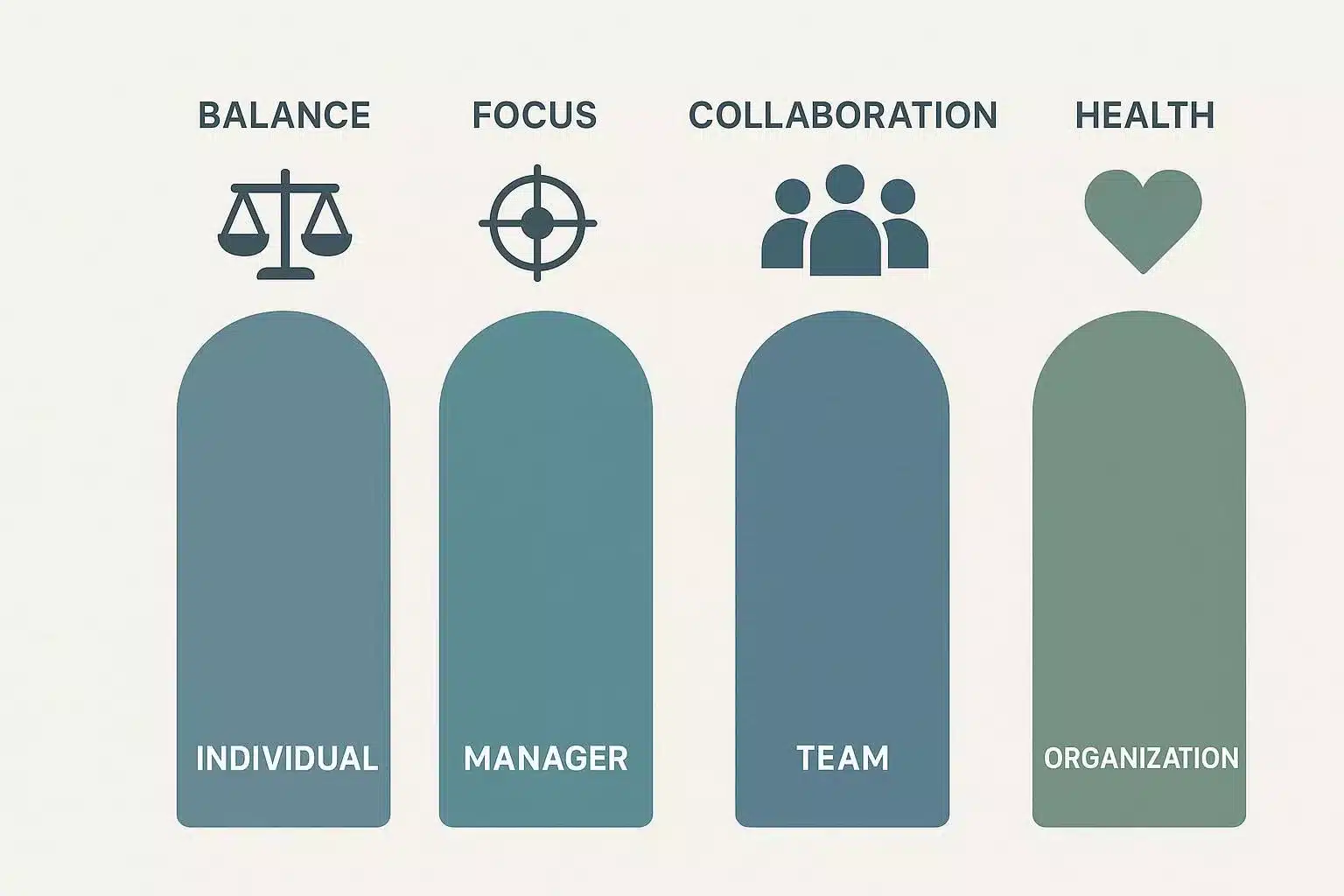
These apps include features such as custom challenges, coaching, reminders, and dashboards that enable organizations to track how people are using the app and the results they achieve.
Here are the main capabilities your vendor should have:
Feature / Module | Why It Matters |
Mental health support | Meditation content, mood check-ins, therapy referrals, stress tools |
Activity & gamification | Movement prompts, fitness challenges, and incentive rewards |
Manager & coaching tools | Suggested check-in scripts, coaching prompts, and team nudges |
System integration | Slack, Microsoft Teams, HRIS, single sign-on (SSO) |
Analytics & reporting | Anonymized dashboards, segmentation, longitudinal tracking |
Depending on your goals, different types may be more relevant:
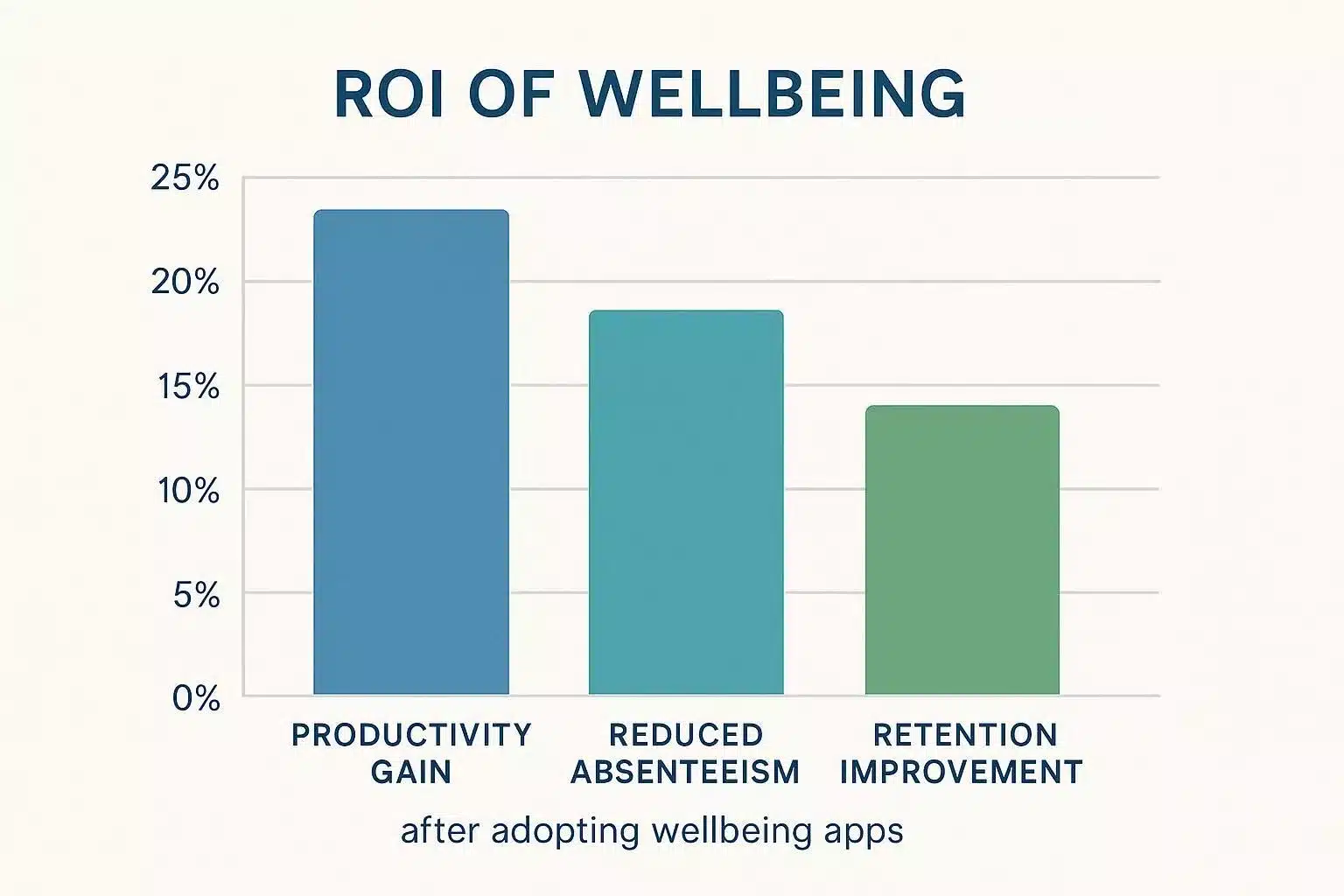
Mental health challenges can silently erode productivity. Studies in The Lancet, HBR, and other sources often cite that well-executed wellbeing programs yield a return of $2 to $4 or more per $1 invested, through reduced absenteeism, improved productivity, and lower turnover.
To clarify, this return is typically considered an annual savings estimate reflecting increased productivity and decreased costs.
According to studies from sources like Sonder and research published in The Journal of Occupational Health Psychology, such figures are validated and can help finance leaders see the financial viability more clearly.
McKinsey’s Thriving Workplaces report estimates that global investment in employee health could yield up to $ 11.7 trillion in value through gains in productivity, retention, and health.
Additionally, some studies have found that happier employees are ~13% more productive, and organizations with a strong “culture of health” see ~11% lower turnover.
While every organization differs, in case studies and ROI models, programs often achieve:

Note: These tools cover a range of uses, including mental health, fitness, coaching, and engagement. The best choice for your organization depends on your main challenges, culture, and budget.
Tool | Key Features | Who It’s For | What It Solves | Pros | Cons | Pricing |
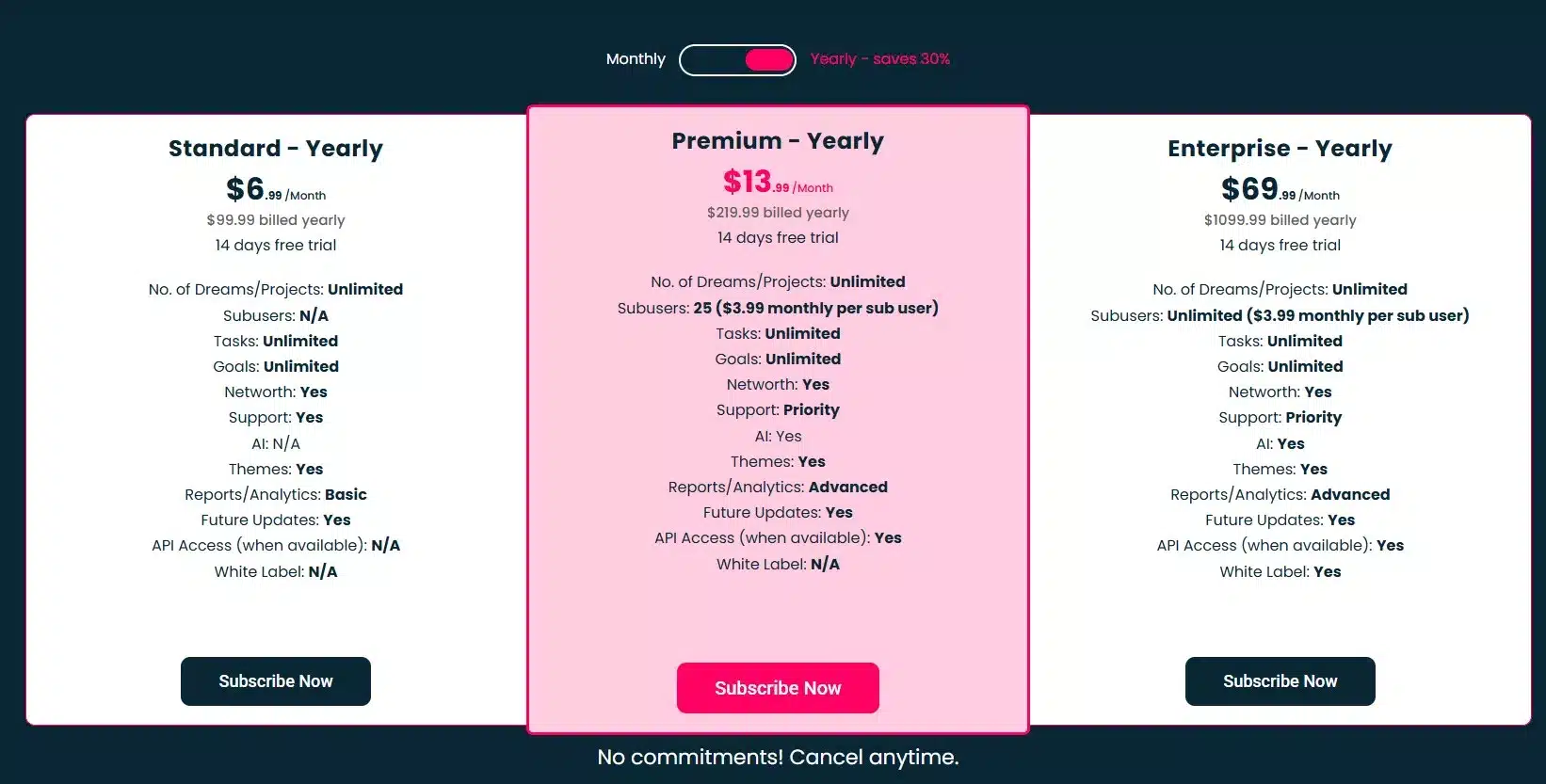
Siddhify | Unified task + wellbeing platform, manager prompts, AI task planning, analytics, privacy-first | Small teams, agencies, remote/hybrid teams | Burnout, scattered workflows, low engagement, lack of manager-led wellbeing | Integrates productivity + wellbeing, manager-driven prompts, GDPR compliant, scalable | Newer tool, fewer case studies publicly available | Free / Standard $6.99–$9.99/mo / Premium $13.99–$19.99/mo / Enterprise $69.99–$99.99/mo |
Empuls | Wellness challenges, rewards, recognition, engagement tracking | Mid-size & large organizations | Employee engagement, recognition, culture-building | Strong reward system, social recognition, analytics | Less focus on mental health content | Custom pricing |
Wellable | Custom wellness programs, fitness challenges, analytics, reporting | SMBs & enterprises | Physical wellness, team engagement | Highly customizable, rich analytics | Can be complex to implement | Custom pricing |
YuMuuv | Activity tracking, step challenges, team leaderboards, gamification | Small & mid-size companies | Physical activity engagement, team motivation | Fun gamified challenges, wearable integration | Limited mental health support | Custom pricing |
Vantage Fit | Fitness challenges, activity tracking, nutrition tips, HR analytics | Enterprises, wellness-oriented companies | Physical health, wellness program participation | Integrates with devices, good analytics | Not ideal for smaller teams | Custom pricing |
Headversity | Resilience & mental health training, self-help modules, analytics | Managers, HR teams, employees | Stress, anxiety, resilience | Strong mental health focus, analytics for HR | Limited physical wellness content | Custom pricing |
Wellbees | Personalized wellness suggestions, behavior challenges, reward points | SMBs & enterprises | Habit-building, engagement, wellbeing tracking | Personalized recommendations, gamification | Can require onboarding effort | Custom pricing |
Myles Wellbeing | Physical wellness, daily habit tracking, challenges | UK-focused SMBs | Activity engagement, wellbeing tracking | Simple interface, local market fit | Limited global adoption | Custom pricing |
GoJoe | Mental & physical wellbeing, social-led engagement, inclusive content | Global teams, remote workers | Engagement, holistic wellbeing | Social & inclusive, supports hybrid teams | Gamification may not appeal to all | Custom pricing |
Calm for Work | Mindfulness, meditation, stress management, sleep support | Employees, managers, teams | Mental health, stress reduction | Trusted brand, strong content | Less integration with HR systems | Subscription-based (varies) |
A 90-day pilot gives you just enough time to test adoption, measure early indicators, and decide whether to scale. To ensure a smooth rollout, prioritize stakeholder alignment and ensure the necessary IT setup in advance.
This preparation will help HR leaders coordinate effectively and address potential challenges before they arise.
Phase | Key Activities |
30 Days | Set up integrations, onboarding, baseline survey, and pilot training |
60 Days | Run engagement campaigns, nudges, manager prompts, and track usage |
90 Days | Evaluate KPIs, collect feedback, refine the plan, and decide on scale-up |
KPIs to Monitor:
Communication plan:
“Apps don’t work.”
“Privacy and data concerns.”
“Low engagement over time.”
Use this formula:
The return on investment (ROI) can be calculated using the following formula:
ROI = [(Value Gains – Costs) ÷ Costs] × 100 (Investopedia, n.d.).
Worked example (illustrative):
Use this model in your business case to connect wellbeing to financial outcomes.
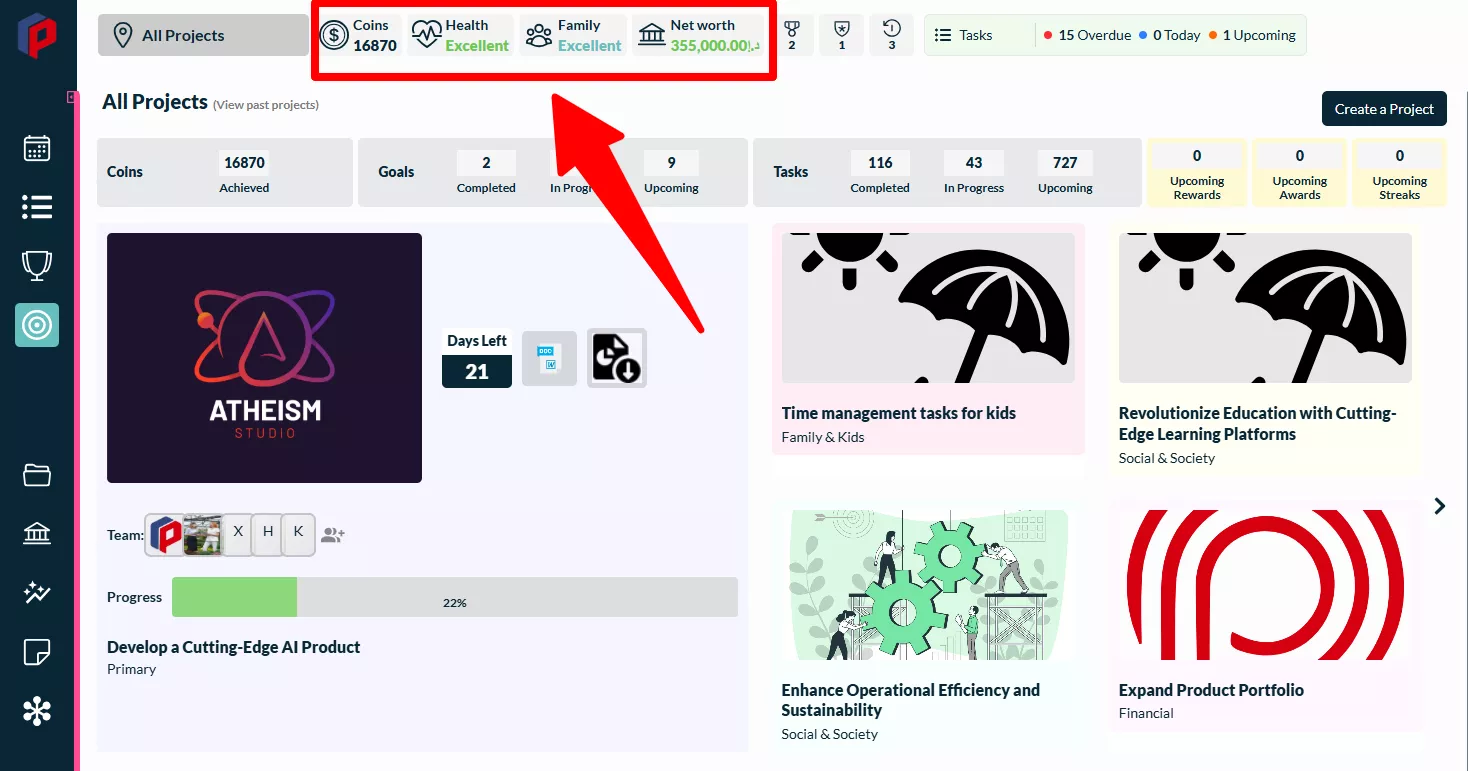
Siddhify is not just another productivity tool; it’s a holistic, AI-powered platform that blends project management, wellbeing tracking, and work-life balance into a single system.
It helps teams manage deadlines and goals while also supporting health, focus, and family life through built-in modules like fitness tracking and a family wellbeing dashboard.
Unlike single-purpose wellness or task apps, Siddhify brings everything together. It integrates goal, project, and task management, wellbeing management, financial analytics, and leadership engagement in one unified workspace.
By merging productivity and wellbeing, Siddhify empowers organizations to improve both performance and mental health.
Tip: Start with a short pilot of Siddhify to measure engagement and stress trends before scaling company-wide. It’s an effective, data-led way to prove impact while keeping your team’s wellbeing at the center of your operations.
Wellbeing app pricing typically includes:
Hidden costs, such as setup, branding, team messaging, HR training, integrating with other systems, making changes, and additional data storage, can significantly increase the total price.
Organizations should systematically assess existing infrastructure, engage vendors for a comprehensive breakdown of potential charges, and establish a contingency budget for unforeseen expenses.
Programs succeed when employees feel heard. Research by Ford et al. (2021) and LaMontagne et al. (2020) shows that wellbeing interventions work only when feedback loops and managerial responsiveness are built in.
Use pulse surveys, suggestion boxes, and open Q&A sessions, and make sure to act on feedback in a visible way.
A digital platform that supports mental, physical, and emotional health through guided tools, analytics, and manager engagement.
Apps like Siddhify lead in 2026 thanks to their blend of AI, coaching, and analytics designed for both employees and managers.
Yes—when supported by leadership and used consistently, they reduce absenteeism and raise engagement scores within 90 days.
Organizations typically see measurable ROI within 3–6 months of structured rollout.
Freemium and SMB-focused plans like Siddhify’s make wellbeing management accessible to smaller teams without large budgets.
Modern platforms anonymize personal information, comply with GDPR, and give users full control over data sharing.
Most charge per user per month, with enterprise options for custom features.
Track absenteeism, retention, and engagement metrics, then apply the ROI formula [(Value Gains – Costs) / Costs] × 100.
It merges wellbeing tracking, AI insights, and manager tools, ensuring engagement and privacy at scale.
Early improvements in engagement often appear within 30–60 days, followed by measurable ROI in 90 days.
Choosing the right employee wellbeing app is a strategic investment, not a checkbox. Siddhify combines manager tools, privacy-first analytics, and AI insights to help organizations build sustainable engagement and reduce burnout.
Don’t just read this. Use the checklist, talk with your team this week, and start a short pilot to see the results for yourself.
Consider a short pilot of an employee wellbeing app, such as Siddhify, to see measurable improvements in engagement and retention.

Join thousands of entrepreneurs and professionals managing their work and life in one place — with the motivational power of gamification built right in.
⚡ Try Siddhify Free TodayNo credit card required · Set up in minutes