Stay in the loop
Get the latest news, feature updates, and exclusive promotions.
Productivity Why Your Productivity AppIs Not Working You set up the system. You colour-coded everything. So why are you still asking yourself — why can't
You set up the system. You colour-coded everything. So why are you still asking yourself — why can't I stick to my goals?

You downloaded the app. You set up your goals. You even colour-coded your tasks. And yet — three weeks later — the app sits unopened and your goals feel further away than ever.
If you've ever asked yourself "why can't I stick to my goals?", the problem isn't your willpower. It's probably your tool. Most productivity apps are built around features, not around the way human motivation actually works.
In this article, you'll learn exactly why popular productivity apps fail most people, what the psychology behind goal-sticking really says, and what a better alternative looks like — one that works with your brain instead of against it.
Every new productivity app comes with the same quiet promise: this time will be different. And for a few days, it actually feels that way. Setting up a shiny new workspace gives you a dopamine hit that mimics the feeling of progress — without actually making any.
Psychologists call this productivity theatre: the act of optimising your system instead of doing the work the system is supposed to help you do. When you spend an evening designing the perfect dashboard, your brain registers it as meaningful activity. But the goal you set hasn't moved an inch.
Most apps accidentally encourage this loop. The more customisable they are, the more time you spend in setup mode. By the time the novelty wears off — usually within two weeks — you're back to square one, already eyeing the next "perfect" tool.
The fix isn't more discipline. It's choosing a system that skips the setup ceremony and gets you into action immediately — because momentum is the only thing that actually builds momentum.

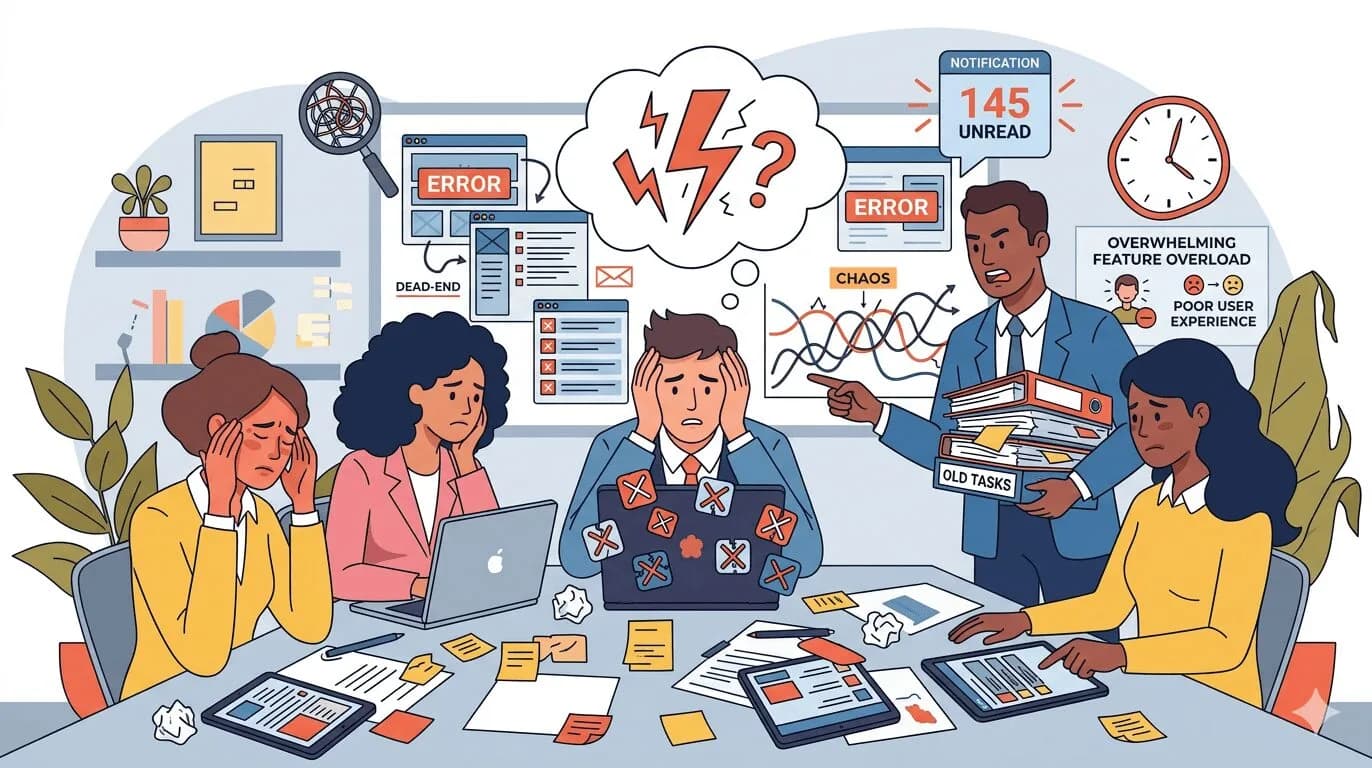
Open any leading productivity app and count the menus. Databases, kanban boards, timelines, automations, integrations — the feature list reads like enterprise software, not a personal goal tracker. This complexity is marketed as "flexibility," but for most people it's just noise.
Barry Schwartz's Paradox of Choice research showed that more options reliably lead to worse decisions and lower satisfaction. When your app can do everything, you spend your cognitive budget deciding how to use it — not on the work itself.
The irony is brutal: you downloaded a focus app and now you're context-switching between its seventeen sub-features. The tool designed to reduce friction is creating it.
The most effective goal-tracking systems share one trait: they have an opinionated structure. They tell you what to do, not just where to put things. Instead of a blank page, you get a guided path. If you're struggling with this, read our guide on building a focused daily routine.
You might think the answer is simply to pick a smaller app — or commit to a big platform with a proven track record. But the reasons people quit are remarkably consistent across both ends of the spectrum. The friction just shows up differently.
The reasons are similar — but they show up differently depending on the tool:
The size of the tool is not the variable that matters. What matters is whether the tool was designed around how people actually build habits — and most weren't.
Humans don't build habits through good intentions. We build them through feedback. Every time you complete a behaviour and something signals well done, your brain is slightly more likely to repeat it. Skip the signal, and the habit never forms.
Most productivity apps are passive containers. They store your tasks and goals but don't respond to your behaviour. There's no streak to protect, no visible proof that you showed up yesterday and the day before. Without that feedback loop, every morning feels like starting from zero.
"Research from University College London found that on average it takes 66 days — not 21 — for a behaviour to become automatic. Your app needs to be with you for that entire journey, not abandoned in week three."
The apps that do include streak tracking often bury them under layers of menus — an afterthought, not the core of the experience. Read our piece on the neuroscience of habit formation to go deeper on why this matters so much.

The final reason people ask "why can't I stick to my goals?" is surprisingly simple: the goals themselves are wrong — not in terms of ambition, but in terms of structure.
Most people write outcome goals: lose 10kg, finish the book, get promoted. These are useful for direction but terrible for daily motivation, because you can't tick them off on a Tuesday morning. Every day the goal is still there, unfinished, staring back at you like an accusation.
Process goals are different. Walk for 30 minutes, write 500 words, send one networking email — these are completable today. They compound into outcomes over time, but they give you a win right now.
Even when your goals are well-structured, without accountability most people quietly stop. A study from the American Society of Training and Development found that people are 65% more likely to meet a goal when they commit to someone else — and 95% more likely with a specific accountability appointment. Most apps offer none of this.
Apps that don't help you break outcome goals into daily process goals are setting you up to feel like a failure — not because you lack discipline, but because the system is structurally working against you.
Siddhify was designed specifically around the failures described above. Instead of a blank productivity canvas, it gives you a structured goal framework that guides you from ambition to daily action — without the setup overhead.
If you've wondered "why can't I stick to my goals?" — the honest answer is that your tools probably haven't been doing their job. The best productivity app isn't the one with the most features. It's the one that gets you into action today, rewards you for showing up tomorrow, and builds the feedback loop that makes quitting harder than continuing.
Stop optimising your system and start using one that was designed to work with how your brain actually changes.
Join thousands of people who stopped tab-hopping between apps and started making real, measurable progress.
Try Siddhify freeJoin thousands of entrepreneurs and professionals managing their work and life in one place — with the motivational power of gamification built right in.
⚡ Try Siddhify Free TodayNo credit card required · Set up in minutes