
Traditional productivity apps were built by neurotypical designers, for neurotypical brains. They assume you can hold priorities in your head, that reminders are enough motivation, and that a blank "Inbox" is a reward. For ADHD brains, these assumptions are wrong on every count.
This guide breaks down exactly why conventional task managers fail people with ADHD — and what an ADHD-friendly project management experience actually needs to look like.
The ADHD brain vs. the to-do list · Why reminders don't work · The dopamine gap · What ADHD-friendly actually means · How Siddhify helps · FAQ
The ADHD Brain vs. The Standard To-Do List
The ADHD brain runs on a dopamine deficit. Without adequate dopamine signalling, the prefrontal cortex — the part responsible for planning, prioritising, and starting tasks — struggles to fire reliably. This isn't a character flaw. It's neurology.
Standard to-do apps are, at their core, just lists. They display tasks with equal visual weight, regardless of urgency, energy required, or emotional stake. For a neurotypical brain, that's enough context to get moving. For an ADHD brain, a flat list of 14 items is cognitively overwhelming — every item competes for attention simultaneously, and the brain defaults to paralysis or distraction.
The problem with "just prioritise it"
Most apps offer priority flags — urgent, high, medium, low. But telling someone with ADHD to manually flag priorities assumes they can sustain the executive function to assess importance while also feeling no urgency to do any of it right now. It's a catch-22. The very act of organising requires the focus that ADHD makes scarce.

Time blindness is real
Research shows that ADHD brains often experience time in only two modes: now and not now. A deadline that's three days away might as well be three months away — until suddenly it's three hours away and panic sets in. Tools that rely on scheduled reminders and future-dated tasks are fundamentally misaligned with this experience.
Why Reminders and Notifications Don't Work
Notification fatigue is a universal problem. For ADHD brains, it's amplified. When every app competes for attention with pings and banners, the brain learns to filter them out — including the ones that actually matter.
But there's a deeper issue: a reminder tells you what to do, not why it matters right now. A pop-up saying "Write project proposal" gives no emotional context, no sense of consequence, and no momentum. It's easy to dismiss and forget within seconds.
Studies in ADHD executive function consistently show that motivation for people with ADHD is interest-based, not importance-based. Tasks get done when they're novel, urgent, personally meaningful, or involve an element of challenge — not simply because they're on a list.
This is why gamification isn't just a gimmick for ADHD users — it's a neurological necessity. Streaks, XP, rewards, and visible progress create the dopamine signal that makes starting a task feel worthwhile.
The Dopamine Gap: What's Actually Missing
Most task managers measure one thing: completion. A task is either done or not done. For ADHD brains, this binary model misses the entire emotional arc of getting things done.
Where's the acknowledgment when you pushed through a hard hour of deep work? Where's the reward for showing up consistently, even imperfectly? Where's the encouragement when the task list grows instead of shrinks?
The absence of positive feedback loops is why ADHD users churn through productivity apps at a rate neurotypical users don't. The app feels neutral at best, punishing at worst — a permanent record of things undone.
Comparison: typical app vs. ADHD-friendly task manager
| Feature | Typical App | ADHD-Friendly Design |
|---|---|---|
| Task display | Flat undifferentiated list | Context-aware, prioritised view |
| Motivation model | Completion checkbox only | XP, streaks, rewards, progress |
| Time awareness | Calendar date reminders | "Now vs later" framing |
| Emotional tone | Neutral / clinical | Empathetic, encouraging |
| Overwhelm handling | Show all tasks always | Focus mode, one task at a time |
| Failure response | Overdue badge, guilt | Gentle recovery, no shame |
What ADHD-Friendly Project Management Actually Means
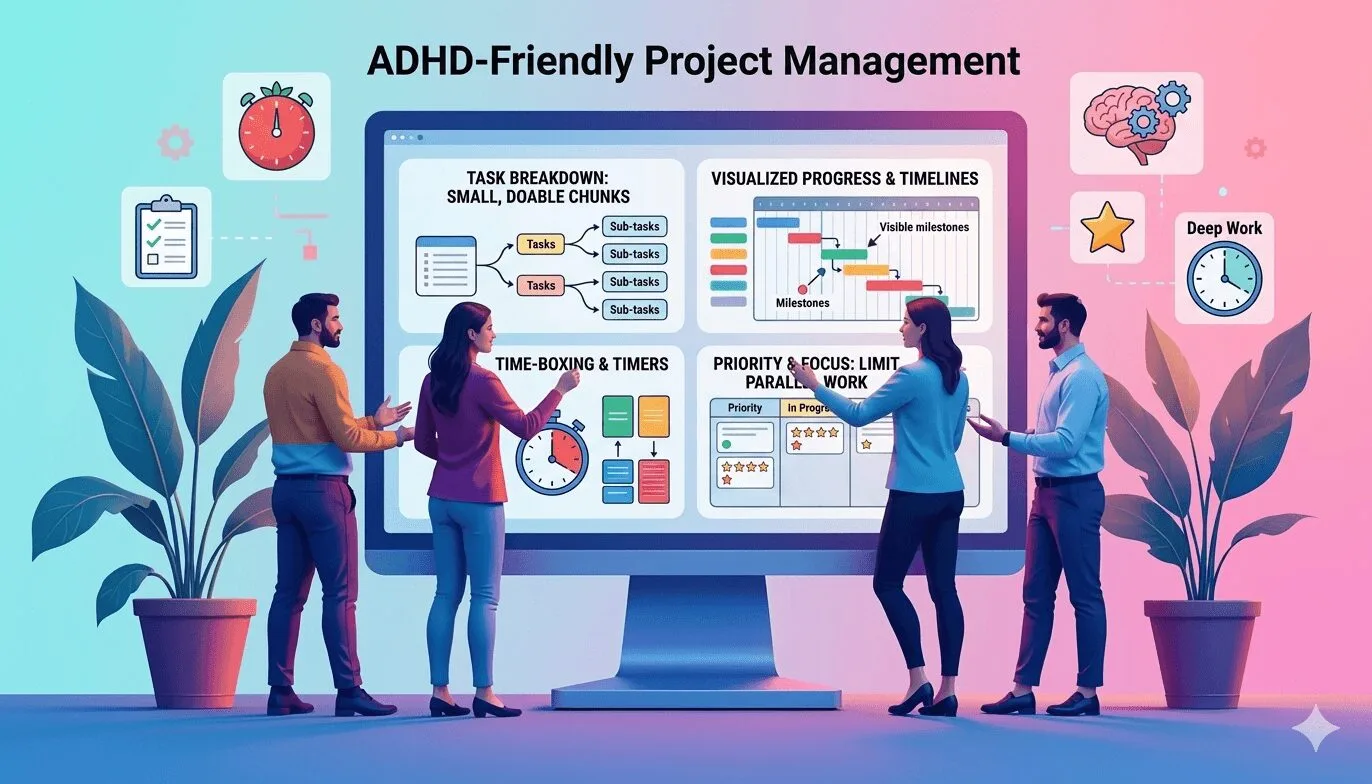
It's not about dumbing things down. ADHD brains are often highly capable, creative, and driven — when the environment supports them. ADHD-friendly design means removing friction, not features.
- Reduce decision load — Surface the right task at the right time, so the brain doesn't have to choose from 30 options.
- Reward progress, not just completion — Celebrate effort, streaks, and milestones, not just finished checkboxes.
- Make urgency visible — Use visual cues, colour, and layout to communicate what's actually important today.
- Allow for imperfection — When someone misses a task, the app should support re-engagement, not punish absence.
- Keep setup minimal — Every field to fill in, every tag to create, every project structure to build is a barrier to starting.
💡 The best task manager for ADHD brains isn't the one with the most features — it's the one that makes starting feel possible, and continuing feel rewarding.
Built for Brains That Work Differently
Siddhify was designed with ADHD, burnout, and low-motivation moments in mind. It's not just a task manager — it's a system that meets you where you are, rewards your effort, and helps you feel progress even on the hard days.
XP & Rewards
Earn XP for completing tasks. Dopamine-driven motivation that makes starting easier.
Streak System
Build momentum with daily streaks — gentle enough to restart, satisfying enough to keep going.
Focus Mode
One task. No clutter. No overwhelm. Just what matters right now.
Progress Visibility
See how far you've come — not just how far you have to go.
Empathetic Design
No shame spirals. Missed a day? Siddhify helps you get back on track, not feel worse.
Frequently Asked Questions
Stop Fighting Your Brain.
Start Working With It.
Siddhify is the ADHD-friendly project management tool built for freelancers, founders, and anyone who's tired of productivity apps that make them feel worse.
Try Siddhify free – no credit card requiredJoin thousands of ADHD brains who finally feel productive.