
Stay in the loop
Get the latest news, feature updates, and exclusive promotions.

Learn how to detect fake digital agency case studies with red flags, real examples, and a 5-step verification framework to protect your marketing ROI.

Case studies are one of the most persuasive tools in a digital agency’s sales arsenal. They act as proof of performance, signal credibility, and help agencies win new contracts. For potential clients, a polished case study often becomes the deciding factor in whether to invest thousands of dollars in a marketing partnership.
But what happens when those case studies are fake?
This report exposes the growing issue of fake case studies in digital agencies, shows how to spot red flags, highlights real-world examples of deception and transparency, and provides a verification framework businesses can use to protect themselves. Drawing on industry research, case comparisons, and tools like Siddhify, this analysis will help decision-makers separate fabricated stories from genuine results.
Case studies dominate marketing. According to the Content Marketing Institute, 73% of B2B marketers use them as part of their content strategy, consistently ranking among the top three most trusted formats for buyers. Yet, a Forrester survey reveals that nearly 70% of clients distrust marketing claims, citing inflated or fabricated case studies as a leading cause.
Fake digital agency case studies often follow predictable patterns:
The consequences are twofold:
This dynamic creates an urgent need for transparency, verification, and accountability in digital agency operations.
Agencies fake or exaggerate case studies for several reasons:
💡 On Reddit’s advertising forum, marketers estimate that 30–40% of agency case studies are fabricated or heavily exaggerated. This is not a minor issue – it is a systemic one.
Detecting fake case studies isn’t always easy, especially for small businesses or startups. But certain warning signs repeat across the industry:
📌 Tip: If results sound too good to be true, they usually are.
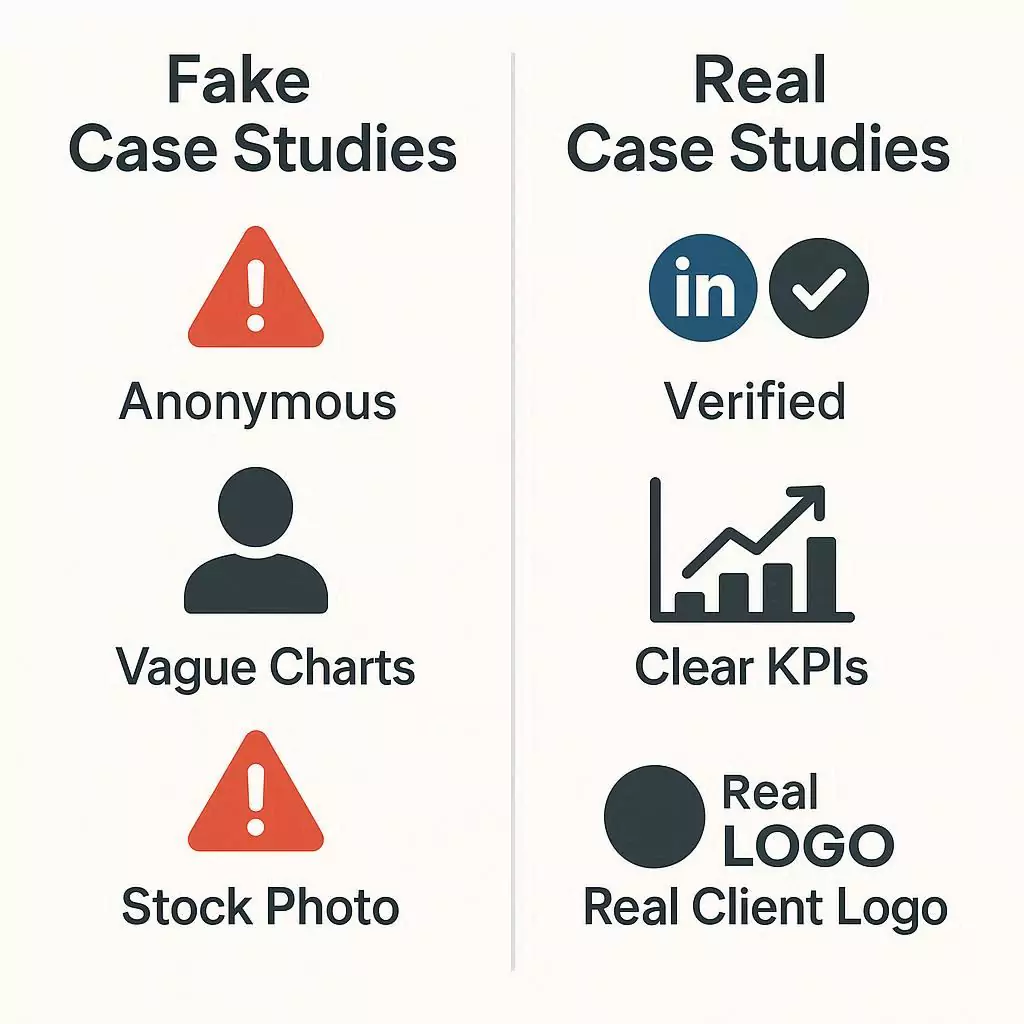
Key Insight: Many agencies recycle case studies, betting clients won’t verify details.
Source: ThinkNEXT
Key Insight: Vanity metrics (clicks, impressions) are easy to fake — ROI is not.
Source: Andava Digital
Key Insight: Transparency builds trust. Real dashboards and verifiable KPIs matter.
Source: ClickCease
Key Insight: The strongest case studies combine narrative with verifiable numbers.
Source: Single Grain
Criteria | Fake Case Studies | Real Case Studies |
Client Name | Vague (“a top SaaS firm”) | Verifiable (Airbnb, Uber) |
Metrics | Generic (“better engagement”) | Quantified (+65% traffic) |
Testimonials | Anonymous, no profiles | Real names, LinkedIn verified |
Visual Proof | Stock images, mock dashboards | Screenshots from analytics tools |
Data Consistency | Unrealistic (500% in 1 month) | Realistic growth timelines |
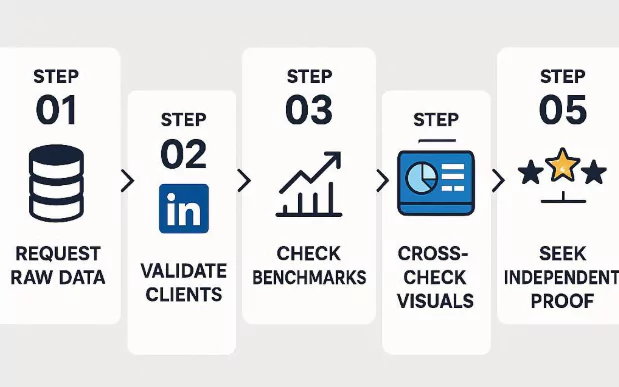
Businesses can protect themselves with a simple five-step process before trusting any case study:
🔑 Agencies that use structured tools like Siddhify make this process easier. Every deliverable, milestone, and performance metric is tracked transparently, giving both teams and clients verifiable proof of work.
A mid-sized SaaS company almost partnered with a European agency claiming to triple MRR in 90 days. The “case study” included:
When the SaaS CMO requested Google Analytics access, the agency refused. Later research revealed the case study was copied from another firm’s blog.
Instead, the SaaS company hired a vetted agency via Clutch, which shared real dashboards and realistic projections. Within six months, they achieved:
📌 If the original agency had used Siddhify for transparent reporting, their claims could have been verified instantly. This example shows how project visibility prevents fraud.

Companies that apply verification steps see measurable benefits:
Check raw data, validate clients, and compare benchmarks. Ask for dashboards, not just PDFs.
To win contracts quickly, stand out in a competitive market, or inflate perceived ROI.
Anonymous clients, vague metrics, fabricated testimonials, and unrealistic growth claims.
Yes. Misrepresentation in business can lead to legal disputes or reputation damage.
Clutch, G2, Trustpilot, LinkedIn, and project visibility platforms like Siddhify.
Yes. Industry discussions suggest up to 40% are fabricated or exaggerated.
Request raw data, ask for client references, and check dashboards for authenticity.
By tracking milestones, deliverables, and campaign metrics transparently, we ensure all reported results are verifiable.

Unmasking the Mirage: A Data-Driven Case Study on Fake Digital Agency Case Studies
Join thousands of entrepreneurs and professionals managing their work and life in one place — with the motivational power of gamification built right in.
⚡ Try Siddhify Free TodayNo credit card required · Set up in minutes